


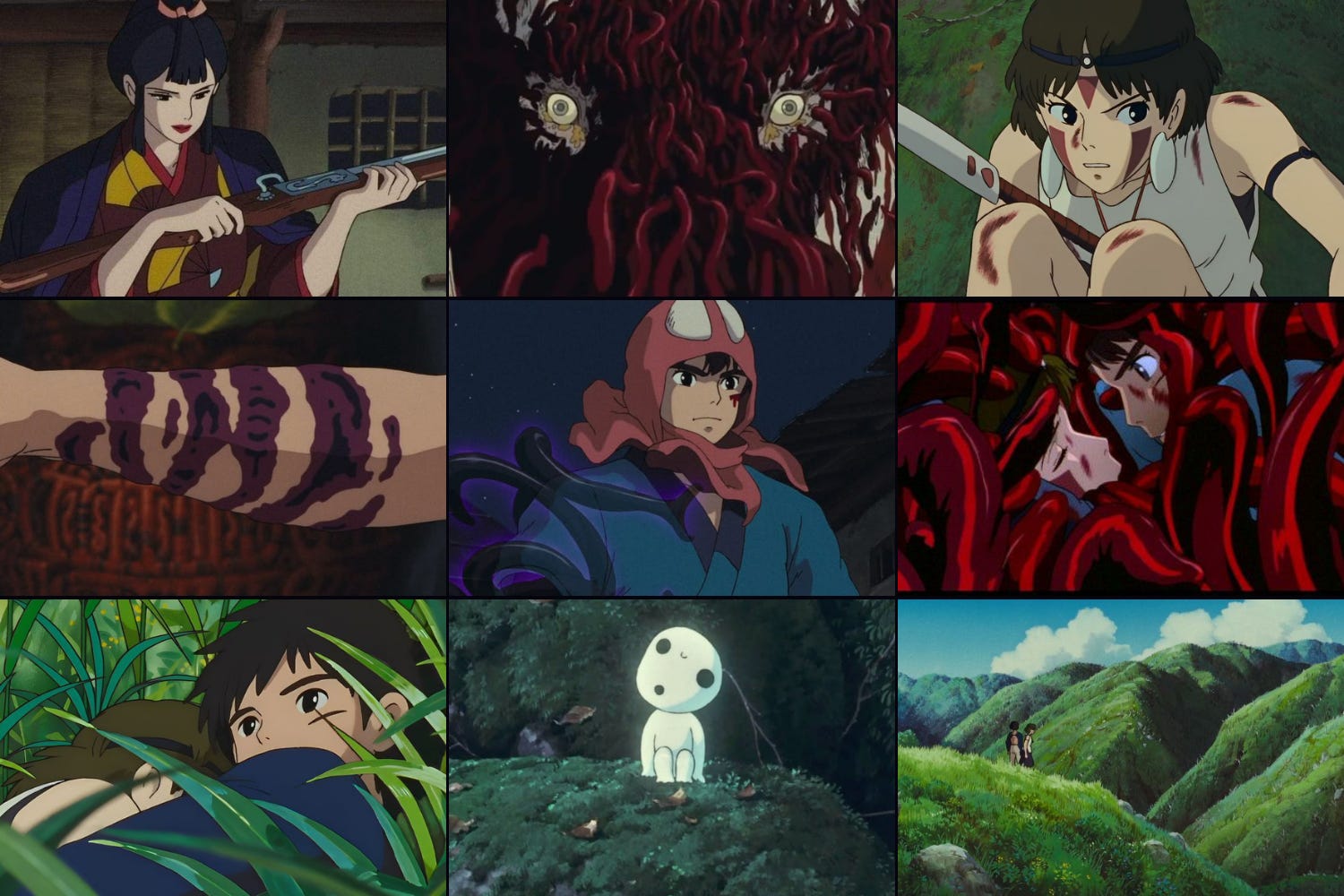
The concept of an industrial civilization that destructively intrudes upon the pure realm of nature is a pervasive one, tracing back to the Romantic era in the American consciousness. Although this has historically furthered conservationist interests with Thoreau as its chief advocate, it has also been used to justify American expansion at the cost of displacement. William Cronon, an environmental historian, defines this dualism as a crude conflict between “human” and “non-human”, which he argues is ultimately unstable. In Hayao Miyazaki’s 1997 Princess Mononoke, this binary is further challenged by its refusal to make clear moral judgements. Through the wilderness dualism that Cronon outlines, Lady Eboshi represents a civilization that stands in stark contrast to the pure wilderness myth San performs; however, as Ashitaka mediates their conflict, he both critiques and complicates the rigid dualism, offering a more balanced, sustainable middle ground that values interconnected life.
As the leader of Irontown, Lady Eboshi represents a human civilization that views nature as other in order to protect her own people. Leading Ashitaka through her secret garden where her lepers forge weapons, she explains how she means to kill the forest spirits she calls “monsters”. At the precise moment the audience is inclined to view her as a villain, the film complicates this by showing a long shot of her being surrounded by the outcasts she has taken in. Yet still, fueled by the Boar God’s rage, Ashitaka indicts her use of weaponry as a means to “breed new hatred and evil”. Before his curse can manifest into an outburst, one of the lepers begs him not to kill her, thus revealing how her violence is rooted in a desire to protect her people through the use of industrialization (Miyazaki 39:33-41:33).
Cronon examines how dualism ignores the “complex cultural historical reasons” (20) why wilderness may be viewed differently among different people. In the case of Mononoke, Lady Eboshi’s motivation to kill the forest spirits and use nature to empower her settlement comes during a time of war, which is completely left out when adhering to a strict binary framework. Though she actively exploits and does not value forest life, it is out of preservation for her own people, not malice.
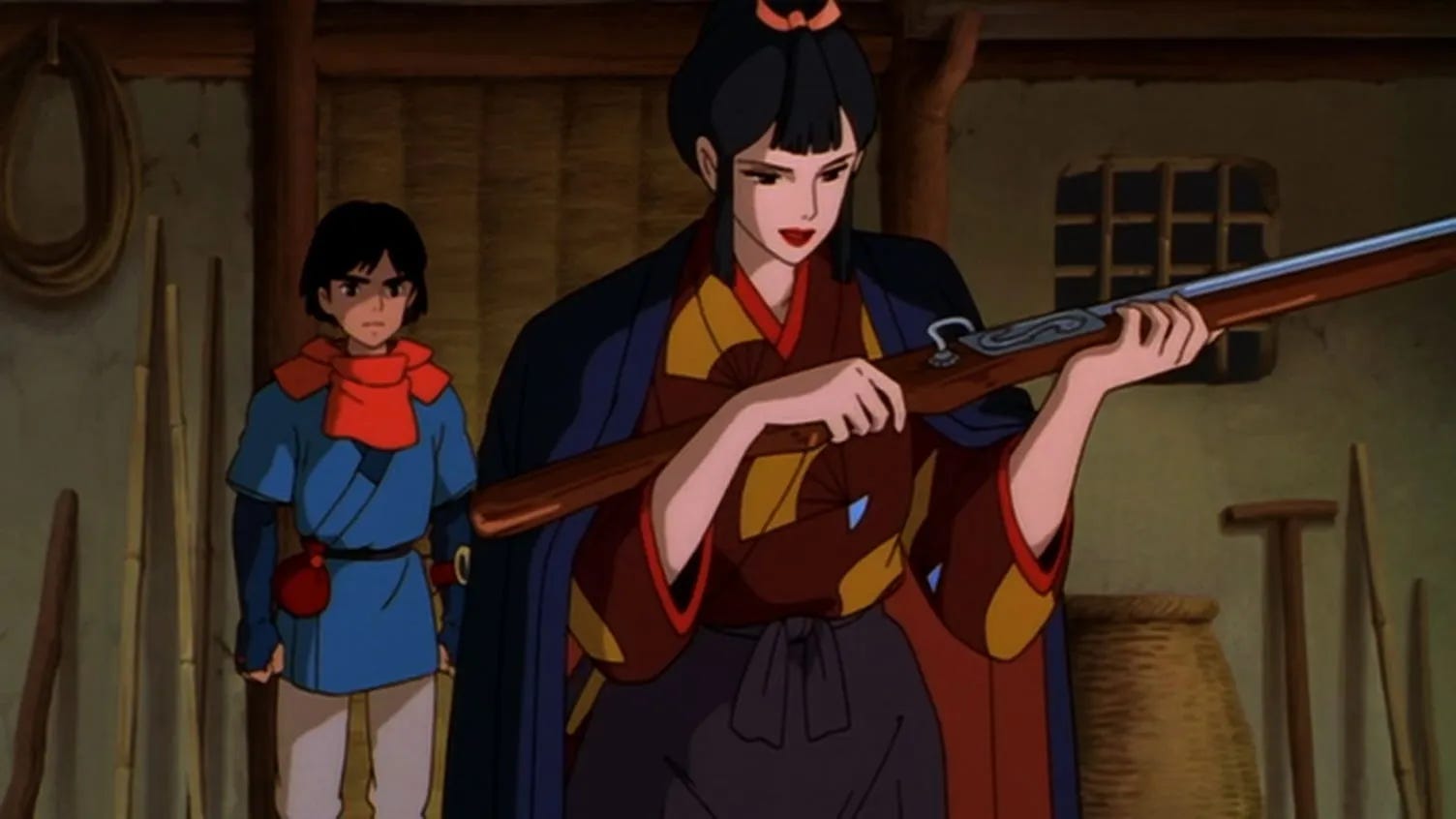
San, on the other hand, performs the myth of pure wilderness through her hyper identification with nature which ultimately cannot be sustained. After Lady Eboshi has killed the Deer God and caused the forest to start collapsing, Ashitaka still attempts to save her life, reflecting how his morality rejects binaries. As a result, San lashes out against him when he asks for her help, claiming that he is “on their side”, or not on the side of wilderness. As he approaches her, she responds in volatile outbursts, drawing herself further into denial while exclaiming that she hates humans and that she is a wolf. It is only after Ashitaka embraces her that she is able to face the reality that she does have some responsibility towards humanity (Miyazaki 1:55:36-1:56:31).
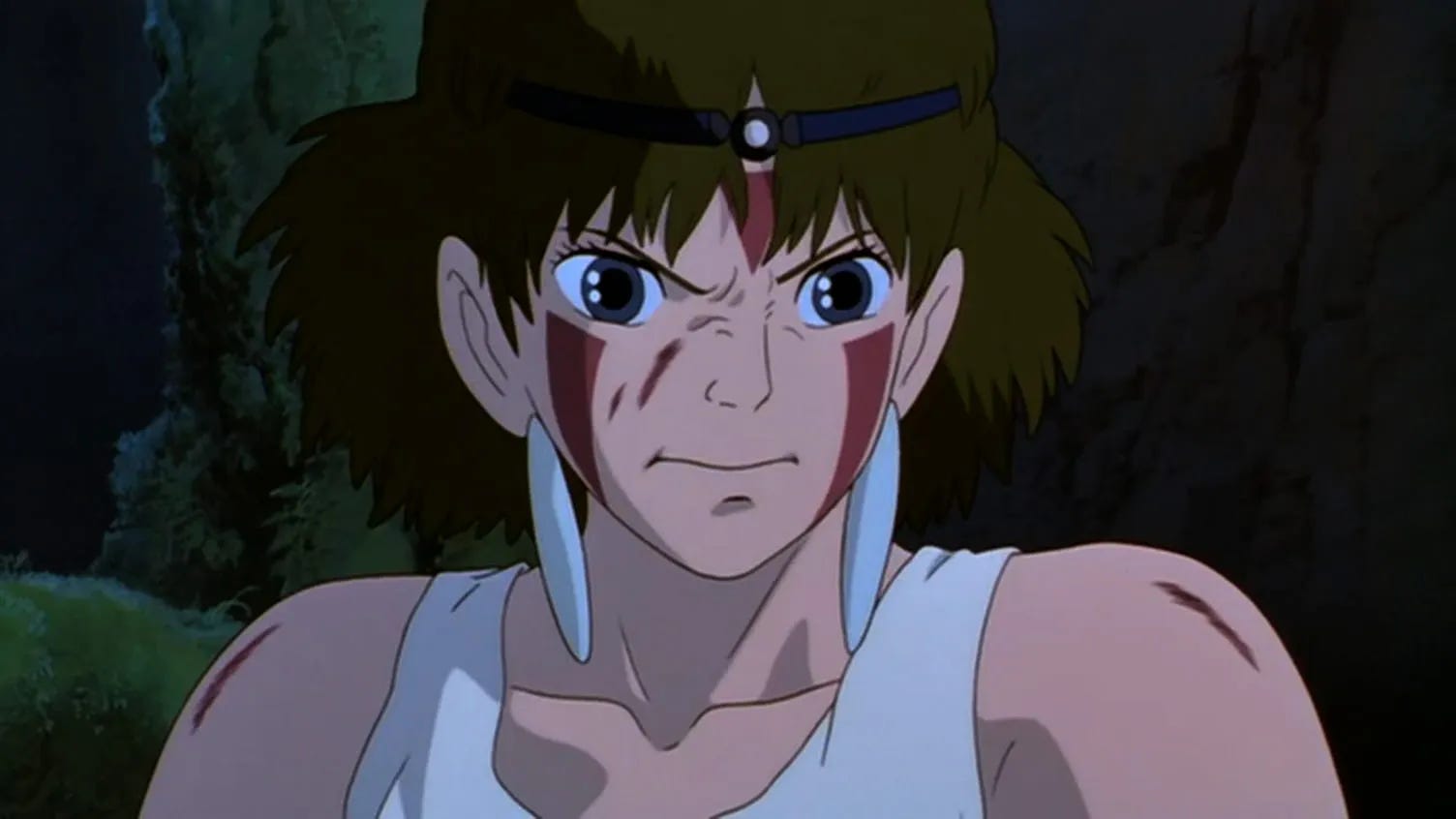
Although San strongly identifies with wilderness, it is a performance she withdraws into that fuels her hatred against her own kind. Her character dramatizes Cronon’s assertion that under dualism she is able to pretend that her “real home is in the wilderness”, and in doing so, she is “forgiving [herself] of the home [she] actually inhabits” (17). San’s hyper identification with nature actively works against Ashitaka’s call for peace, and despite loving her, he still critiques her extreme position by reminding her she is indeed human.
Crucially, as the last Emishi prince of a dying tribe, Ashitaka inhabits a unique vantage point to mediate the conflict between civilization and wilderness. Throughout the film he is given intimate insights into both sides of the conflict, choosing to “see with eyes unclouded”. Because he descends from a people that honors nature, he is already informed by ideas of what harmony amongst it looks like. Even though the Deer God’s head has been “returned by human hands”, this does not mean the complete restoration of his woods. Instead, the god falls back into the water and causes the destruction of Irontown, sending its debris out into the sky’s horizon. It is only then that nature is able to regrow, rendered through slow animation and a piano sequence. While San laments the death of the forest she knew, he assures her that the Deer God cannot die because “he is both life and death” (Miyazaki 2:02:49-2:08:35).
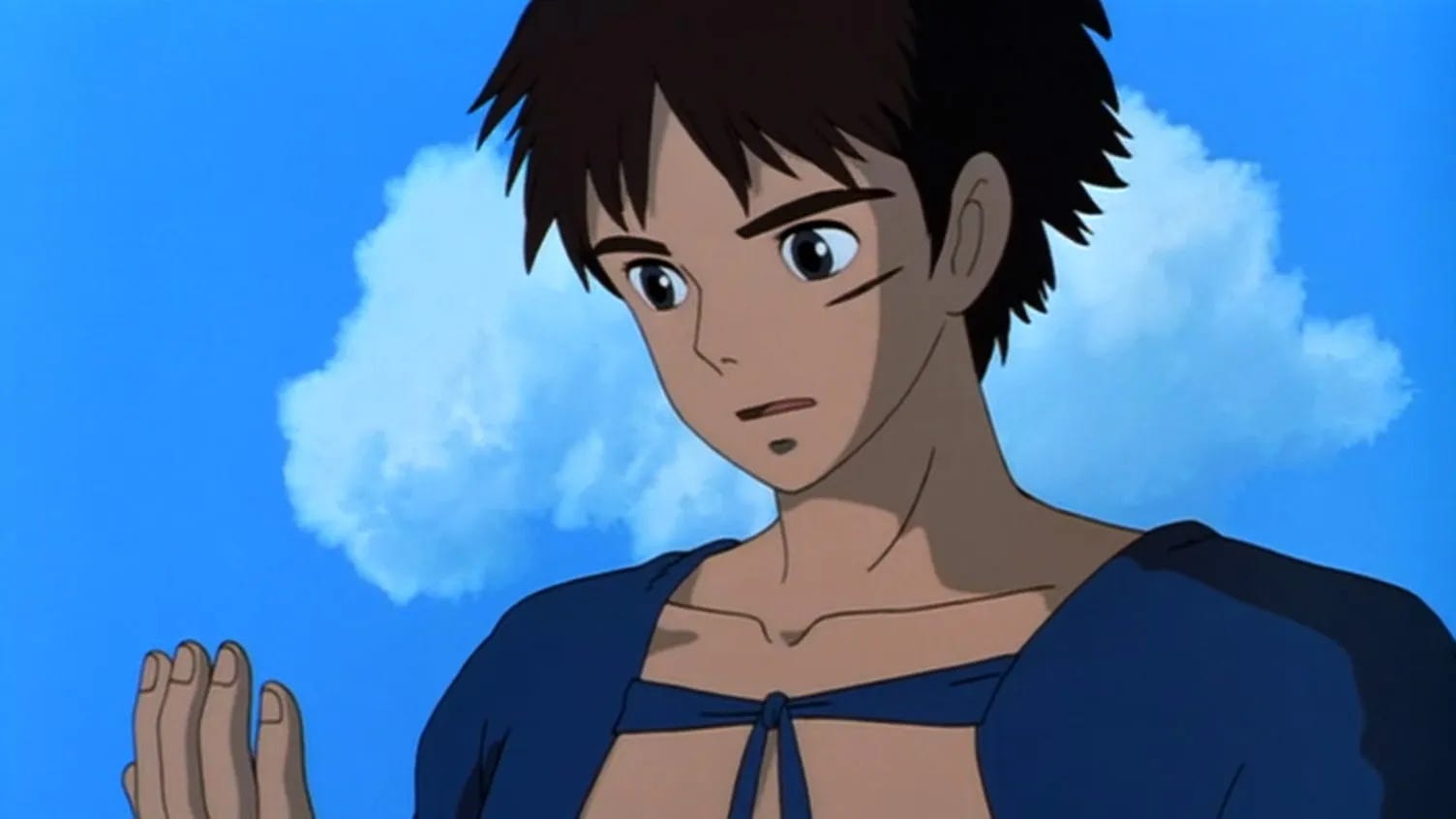
Such a holistic perspective utterly dismantles a wilderness dualism that demands casting judgement without nuance. Furthermore, the film does not end in a clean resolution, but it is through Ashitaka’s efforts that a harmonious compromise is made. This ending reflects Cronon’s assertion that “learning to honor the wild” and “striving for critical self-consciousness” (25) in our actions within nature is what promotes sustainability. His characterization asks not whether humans and nonhumans can live in coexistence, but whether they are not already interconnected.
Miyazaki’s Princess Mononoke challenges western notions of pure wilderness by presenting a film that refuses to create distinct boundaries between man and nature. Cronon’s criticism of this wilderness dualism as a myth is further highlighted through the complex characterization of Lady Eboshi, San, and Ashitaka. Most importantly, all of the key figures involved are human, elucidating how this framework is a uniquely human construct. Viewing the insoluble conflict between civilization and nature as inherently binary risks failing to honor the nature that is already around us. Not only does this lens corrode away at any chance for real peace, it also discourages humanity from recognizing their responsibility to preserve nature as a part of themselves. Rather than using wilderness as a form of escape from civilization often deemed as inherently evil, it would be far more productive to face the reality we are living in if we are to make any meaningful, tangible progress towards restoration.
Works Cited
Cronon, William Cronon. “The Trouble with Wilderness; Or, Getting Back to the Wrong Nature.” Environmental History, vol. 1, no. 1, 1996, pp. 7–28, https://doi.org/10.2307/3985059.
Princess Mononoke. Directed by Hayao Miyazaki, Studio Ghibli, 1997.
If you would like to support my academic and creative work, please consider becoming a paid subscriber for exclusive access to The Marginalia—a living notebook featuring close readings, craft notes, writing process insights, early drafts, WIP excerpts, and curated media lists for deeper exploration.
Or, if you prefer, you can buy me a coffee. Just think of it as tossing a coin to your word witch. Either way, your readership is more than enough🖤
Very insightful! I know what I’m going to rewatch this weekend. I love how you explored how wilderness can be used as a shield.
loved this one, you did one of my fav films justice with this analysis. made me appreciate the male protagonist more (i was firmly on san’s side on first watch).